Vital Role Transparency Insight

Vital Role Transparency
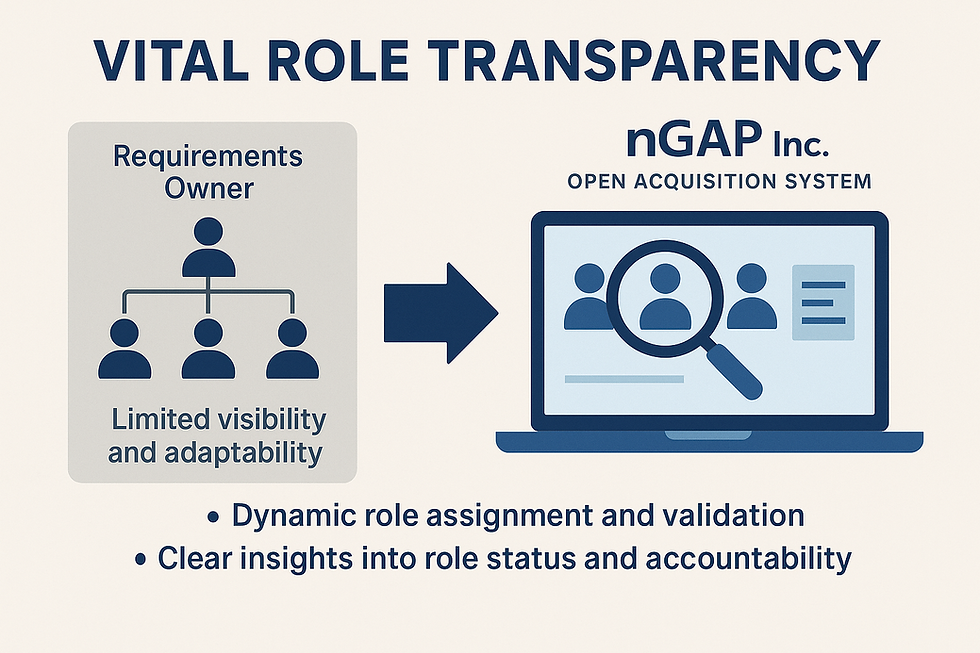
In the world of public sector procurement and defense contracting, accountability and role clarity are non-negotiable. Millions—often billions—of taxpayer dollars flow through procurement pipelines each year, and every stakeholder, from contracting officers to finance reviewers, must be both empowered and accountable. That’s where Vital Role Transparency becomes mission critical.
Enter nGAP Inc's Open Acquisition System (OAS)—a next-generation procurement and contract management platform that puts Vital Role Transparency at the center of every transaction.
What is Vital Role Transparency?

Vital Role Transparency refers to the clear identification, delineation, and traceability of the key individuals—referred to as “vital roles”—responsible for decision-making and approvals throughout the contract and acquisition lifecycle. These typically include:
Ordering Officers
Payment Certifiers
Reporting Officers
Requirement Owners
In legacy systems, the connection between roles, decisions, and accountability is often buried in PDFs, buried emails, or siloed spreadsheets—leaving room for ambiguity, errors, or even fraud.
How OAS Reinvents Vital Role Transparency
Unlike legacy ERP and acquisition platforms that often obscure or fragment role-based responsibilities, OAS embeds Vital Role Transparency directly into its software architecture. Here’s how:
1. Role-Centric Audit Trail
Every action taken within OAS—whether initiating a requisition, obligating funds, certifying payment, or closing out a contract—is automatically attributed to a specific named individual in a vital role. This ensures total traceability and zero ambiguity.
2. Dynamic Role Assignment and Validation
OAS enables live configuration of roles based on organizational hierarchy, funding source, or mission type. Each acquisition package enforces role presence and validity before progressing—no ghost approvals, no missing actors.
3. Real-Time Transparency Dashboards
Users and leadership can instantly view:
• Who is assigned to each vital role in an acquisition
• Whether the role is compliant and authenticated
• Where bottlenecks are occurring
• Who approved or delayed what, when, and why
Legacy systems usually require custom reports, manual log tracing, or emailing three departments to figure this out.
4. Built-In Separation of Duties
OAS prevents role conflicts automatically. For example, a single user cannot both authorize a contract and certify its payment—a critical control that many legacy systems require manual enforcement or policy memos to address.
5. Role Handoff and Delegation Logs
When roles are reassigned (due to leave, reassignment, etc.), OAS documents this transition—ensuring no loss of accountability and allowing full traceability of interim decisions. Legacy systems tend to lose this context, especially when managed through static documents or email threads.
Why Legacy Systems Fall Short
Feature | Legacy Systems | OAS (Open Acquisition System) |
Role Traceability | Scattered across emails, PDFs, and logs | Centralized and automated per transaction |
Role Validation | Manual, often post-facto | Real-time enforcement at workflow level |
Auditability | Requires external reconciliation | Fully integrated and exportable |
Delegation History | Rarely tracked | Logged and searchable |
Enforcement of Role Separation | Requires policy oversight | Automated and non-bypassable |
Legacy systems were designed for compliance at the document level—OAS was designed for compliance at the decision and role level. That’s a seismic shift.
The Strategic Impact
By operationalizing Vital Role Transparency, OAS doesn’t just meet audit and compliance requirements—it makes them visible to the user. That means:
Vital Role Transparency isn’t just about tracking who did what—it’s about building a culture of visible responsibility, data-driven governance, and mission-aligned accountability.
With OAS, nGAP Inc has built a system where vital roles aren’t hidden behind bureaucracy—they’re front and center, measurable, and accountable from day one.
Legacy systems left transparency to interpretation, OAS makes it non-negotiable.