Standardization with Flexibility in Government Contracting
- nGAP Inc
- Nov 10, 2025
- 3 min read

In the evolving landscape of federal acquisition and contracting, agencies face constant pressure to improve transparency, accelerate procurement, and ensure compliance with complex regulations. nGAP Inc.’s Open Acquisition System (OAS) is designed to meet these challenges head-on, offering a unified digital platform that delivers both standardization and flexibility across the government contracting lifecycle.
Core Capabilities of OAS
OAS is an end-to-end solution that enables agencies to manage every phase of the acquisition process — from planning and solicitation to contract execution and closeout — all within a single, integrated environment.
Key capabilities include:
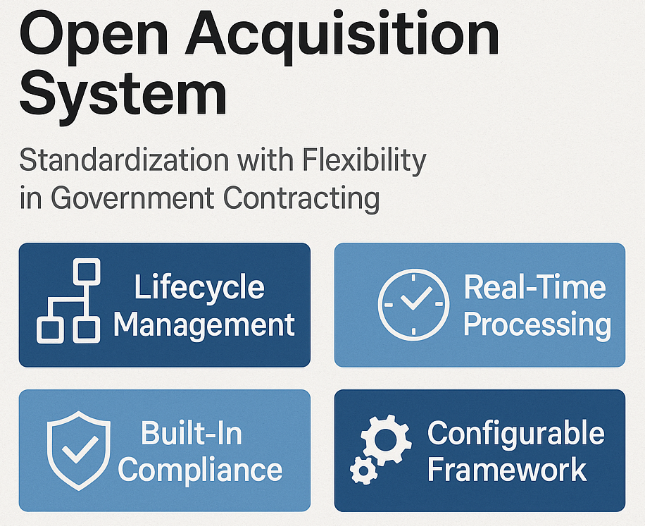
Lifecycle Management: Streamlined handling of acquisition phases through standardized workflows and templates.
Real-Time Processing: Instant updates and data visibility across the procurement chain.
Built-In Compliance: Automated checks ensure adherence to FAR and DFARS requirements.
Audit Readiness: Continuous audit trails and documentation to support accountability.
Configurable Framework: The system can adapt to unique agency policies, contract types, and legacy integrations.
This approach minimizes redundant manual effort, improves oversight, and ensures consistency across decentralized acquisition offices.
The Standardization Advantage
Standardization is critical in government contracting. OAS provides agencies with a consistent structure for every contract, ensuring that essential compliance and procedural steps are never overlooked.
Benefits include:
Uniform Templates and Clause Libraries aligned with federal regulations.
Automated Approval Workflows that reduce bottlenecks and human error.
Centralized Data Management that eliminates duplication and supports unified reporting.
This structure enhances transparency, accelerates audits, and enforces accountability across procurement teams.
The Flexibility Factor
While standardization improves reliability, flexibility enables agility — and OAS strikes a precise balance between the two. Through configurable workflows and modular design, OAS allows agencies to tailor processes, clause sets, and approval chains to specific missions, programs, or contract vehicles. This flexibility allows contracting professionals to respond quickly to evolving requirements or regulatory changes, ensuring procurement operations remain mission-ready without sacrificing compliance.
Architectural Design: A Modern Foundation for Federal Acquisition
At its core, OAS employs a modular, cloud-based architecture that supports interoperability and scalability. Its API-driven integration framework allows seamless connectivity with existing systems such as financial management, vendor databases, and document repositories.
Key architectural elements include:
Microservices Architecture: Ensures modular functionality that can evolve without system-wide downtime.
Role-Based Access Control: Provides secure, compartmentalized user access.
Real-Time Data Layer: Enables up-to-date tracking of financial obligations and contract performance.
Audit-Ready Data Fabric: Preserves historical data for oversight, inspections, and congressional reporting.
This infrastructure empowers agencies to standardize critical acquisition functions while retaining the flexibility to adjust modules or workflows as regulations and missions evolve.
Use Cases Across Government Agencies
OAS has demonstrated success in diverse agency environments, particularly within the defense and civilian sectors:
Defense Acquisition: Supports high-value procurements with complex oversight needs, ensuring traceability from funding to field deployment.
Civilian Agencies: Simplifies procurement for IT modernization, research grants, and services, reducing administrative delays.
Program Offices and Contracting Commands: Enhance cross-team collaboration by providing a single source of truth for procurement data.
These implementations have led to measurable improvements in efficiency, audit readiness, and cycle-time reduction for contract awards.
OAS vs. Traditional Contracting Systems
Unlike legacy acquisition platforms that emphasize rigid workflows or static document repositories, OAS transforms the contract itself into a living, digital entity.
Feature | Traditional Systems | OAS (Open Acquisition System) |
Process Flexibility | Rigid, limited customization | Configurable workflows and clause sets |
Compliance | Manual checks | Automated, embedded FAR/DFARS logic |
Data Visibility | Fragmented, static reports | Real-time analytics and dashboards |
System Integration | Limited interoperability | Open API architecture |
Audit Trails | Periodic and manual | Continuous and automated |
OAS redefines contracting as a dynamic, data-driven process rather than a static paperwork function — enabling a smarter, faster, and more accountable acquisition environment.
Why It Matters
Government procurement is under growing scrutiny for efficiency and accountability. OAS directly addresses these challenges through:
Enhanced Oversight: Every contract action is traceable, searchable, and verifiable.
Reduced Administrative Burden: Automation frees acquisition professionals for mission-critical work.
Improved Audit Outcomes: Continuous compliance and documentation reduce audit risks.
Cross-Agency Scalability: Standardized frameworks can be shared across departments, promoting interagency alignment.
With OAS, agencies no longer have to choose between process uniformity and operational adaptability — they can achieve both simultaneously.
Conclusion
nGAP Inc.’s Open Acquisition System stands as a breakthrough in government contracting modernization. Its dual promise of standardization with flexibility allows agencies to streamline operations, uphold compliance, and remain responsive to dynamic mission needs. In an era where transparency, agility, and accountability define procurement excellence, OAS provides the foundation for a more efficient, auditable, and future-ready acquisition ecosystem.