Bridging the Communication Gap in DoW Acquisition: How OAS and Savantir Can Help Solve the Failure to Communicate

In the recent white paper released by George Mason’s Costello College of Business, Moshe Schwartz, Michelle V. J. Johnson, and Daniella Schwartz diagnose a critical barrier crippling Department of Defense, now known as the Department of War, acquisition: poor communication. As the authors put it, “breakdowns in communication—or the absence of robust communication—have led to subpar requirements, inefficient budgeting, increased bid protests, poor acquisition outcomes, increased costs, and a strained DoW–industry relationship” (Schwartz, Johnson, & Schwartz). They argue that the DoWs communication shortcomings manifest across three axes: DoW ↔ industry, DoW↔ Congress, and internal DoW officials.
The white paper recommends a communication framework based on principles such as timeliness, bidirectionality, meaningfulness (not formulaic), relational orientation, trust building, and promotion of collaborative new knowledge (Schwartz, Johnson, & Schwartz). The question then becomes: how can modern software systems embed or support exactly such principles in practice, rather than relying purely on policy, process, or training?
Enter nGAP Inc’s OAS (Open Acquisition System) and Savantir—technology platforms engineered to operationalize transparent, interactive, and traceable communication throughout the acquisition lifecycle. Below is an outline on how they align with the challenges and prescriptions of the white paper, and how they may represent practical paths forward to overcoming “failure to communicate.”
Communication Failures: Key Challenges Identified in the White Paper
Before mapping to solutions, it is useful to restate the most salient communication failures the white paper highlights:
Lack of clarity & withholding information
The authors cite pervasive ambiguity in requirement statements, bid documents, and internal guidance, sometimes exacerbated by parties withholding information to gain negotiation advantage or maintain control.
One-way, formulaic communication
Rather than enabling iterative discourse, many acquisition communications are unidirectional—DoW issues a solicitation, and industry responds. Such communications often become transactional rather than relational.
Internal siloes and poor coordination
Within DoW, different offices (program offices, legal, budgeting, oversight) often act in isolation, lacking shared visibility into evolving requirements or stakeholder feedback.
Erosion of trust and adversarial interactions
When communication is opaque or inconsistent, industry and other stakeholders view DoW interactions with suspicion, contributing to bid protests, fewer qualified proposers, or a shrinking defense industrial base.
Delayed feedback cycles and reactive posture
The white paper underscores that responsiveness is essential but often feedback from industry or internal reviews comes too late to meaningfully influence solicitations or design decisions.
These failure modes lead directly to the negative outcomes the authors warn about fewer competitors, weaker proposals, wasted cost, and diminished innovation. As they caution, “failure to improve communication will lead to DoW having less competition, less access to advanced capabilities, and a defense industrial base that is disconnected from the greater dynamic national industrial base” (Schwartz, Johnson, & Schwartz).
In sum, the root challenge is structural: communication in DoW acquisition is under-engineered. Policy and procedural reform alone may not fully suffice unless accompanied by technological systems that enforce, facilitate, and monitor good communication practices.
OAS (Open Acquisition System): Embedding Communication into the Acquisition Platform
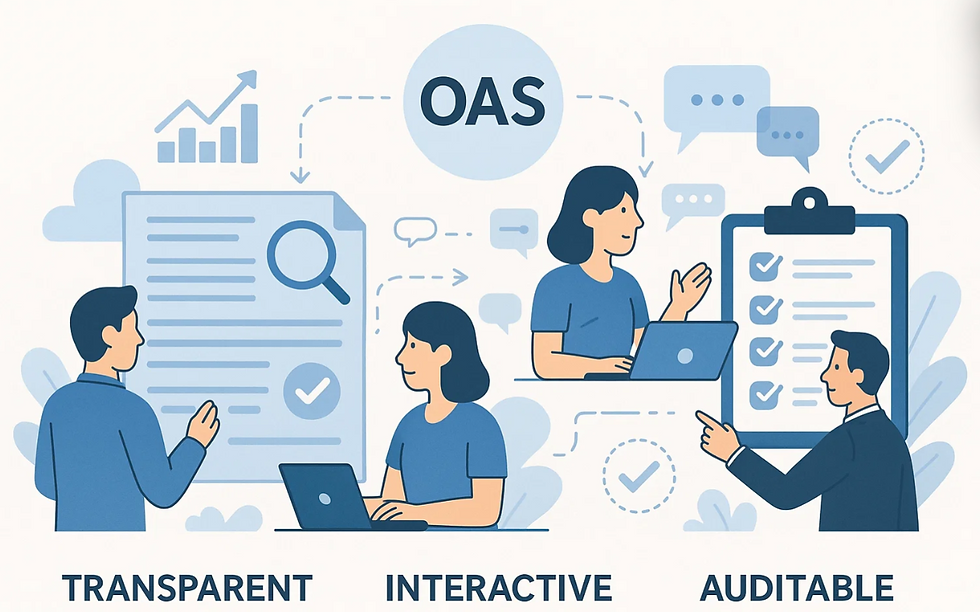
OAS is designed from the ground up to render the acquisition process more transparent, interactive, and auditable. Here’s how OAS can address the white paper’s recommendations in concrete ways.
1. Timely, bidirectional communication as default
OAS allows real-time messaging, issue tracking, and comment threads directly on solicitation artifacts (e.g. requirement sections, RFP clauses, evaluation criteria). Industry partners, DoW program offices, legal reviewers, and oversight entities can post questions, clarifications, or suggestions, and see replies in context. Because the platform timestamps and version-tracks all interactions, communication is not only timely but traceable.
This mechanism aligns with the white paper’s call to “be timely and responsive to feedback” and to allow “information to flow both ways along the communication channel” (Schwartz, Johnson, & Schwartz).
2. Contextual visibility and shared understanding
Rather than siloed documents, OAS presents a consolidated “living solicitation” view, integrating technical requirements, cost models, schedule assumptions, evaluation criteria, and amendment change logs. Stakeholders can view dependencies and cross-references, reducing ambiguity or contradictory instructions.
This capability supports the authors’ admonition to make communications “meaningful, not formulaic,” and to treat each communication “as part of a larger relationship” rather than disconnected transactions.
3. Trust via provenance and audit logs
Every edit, comment, response, and decision in OAS is logged with author, timestamp, and change rationale. If a requirement is revised after industry feedback, the system retains the prior version and shows what prompted the change.
Such auditability helps establish institutional trust—stakeholders can see that DoW is transparent, not capricious—which addresses the white paper’s emphasis on building trust as a central pillar of better communication.
4. Collaborative knowledge building and templating
OAS supports collaborative drafting of solicitation templates, lessons-learned annotations, and reusable component libraries (for example, standard interface descriptions, test plans, evaluation templates). Over time, this builds a shared knowledge base (both internal and industry-facing), thus advancing the white paper’s goal to “build new knowledge collaboratively.”
5. Protest mitigation and decision support
Because OAS maintains a traceable chain of communication, responses to industry queries (and the rationale for accepting or rejecting them) are clearly documented and visible to oversight. This transparency can reduce the incidence of contested solicitations by minimizing ambiguity or unfairness in replies. The white paper cites decreased bid protests and improved future competition as key benefits of better communication (Schwartz, Johnson, & Schwartz).
Savantir: Intelligence, Analytics, and Workflow to Surface Communication Risks

While OAS provides the core interactive acquisition platform, Savantir complements that with analytics, alerts, and decision support designed to surface communication breakdowns before they metastasize. Below are some ways Savantir works within OAS.
1. Communication anomaly detection
Savantir can monitor thread activity, response latencies, and comment volumes. If a requirement block receives multiple clarification requests but no response for a defined threshold, the system flags it as a “communication risk zone.” That allows program managers or contracting officers to intervene proactively ensuring that feedback loops remain timely and responsive.
2. Sentiment & consistency monitoring
Using natural language processing, Savantir can parse industry feedback comments (e.g., “ambiguous,” “contradicts clause 3.2,” “insufficient detail”) and categorize them. It can also scan for contradictory instructions (e.g. different offices giving conflicting guidance on a requirement). This helps prevent formulaic or inconsistent communication—the very pitfalls the white paper warns against.
3. Stakeholder engagement scoring and coverage gaps
Savantir can maintain metrics on how many unique industry entities have submitted questions, how many responses each received, and whether any stakeholder appears neglected. Low participation in key sections signals a possible deterrent effect, which might require additional outreach or clarification posting.
4. Historical patterns and competitive dynamics
By correlating past acquisition rounds, protest outcomes, and communication metrics, Savantir can highlight correlation trends (e.g. solicitations with high bid protest rates often had many unanswered industry inquiries late in the cycle). This insight supports continuous improvement and reinforces the relational approach the authors advocate.
5. Workflow integration and escalation management
Savantir can embed itself into governance workflows: when a communication issue is flagged (e.g. unanswered question > X days), it can escalate to higher levels (contracting officer, legal counsel, program lead). This enforces accountability, ensuring “communication is encouraged” across layers—as the white paper prescribes.
Why OAS + Savantir Together Advance the White Paper’s Communication Framework
When considered together, OAS and Savantir operationalize the white paper’s prescriptions in complementary fashion.
White Paper Principle | OAS (Platform) | Savantir (Analytics / Policy Guardrails) |
Timely & responsive feedback | Real-time commenting, threaded Q&A | Alerts on delayed responses |
Bidirectional flow of information | Industry + DoW both contribute in context | Monitors skewed response ratios |
Meaningful, not formulaic | Context-aware responses, versioned edits | Semantic analysis of content quality |
Relational orientation | Shared workspace, reusable templates, continuity | Stakeholder engagement metrics, sentiment tracking |
Build new knowledge collaboratively | Co-developed templates, shared libraries | Analytics on reuse, institutional learning |
Establish trust | Full provenance, audit logs, visible rationale | Transparency dashboards, protest risk predictions |
Encourage communication across layers | Multi-stakeholder participation, threaded visibility | Escalation workflows, cross-org alerts |
By embedding communication into the core acquisition workflow (OAS), and by adding proactive oversight, metrics, and analytics (Savantir), the pair ensure that the white paper’s ideals are not just aspirational but materially enforced.
Conclusion
The George Mason white paper pinpoints a core root cause of many acquisition inefficiencies: poor, one-directional, or opaque communication. As the authors warn, “failure to improve communication will lead to DoW having less competition, less access to advanced capabilities, and a defense industrial base that is disconnected …” (Schwartz, Johnson, & Schwartz).
nGAP Inc.'s OAS (Open Acquisition System) and Savantir, when deployed together, offer a practical, software-centric pathway to realize the very communication principles the paper prescribes: timely, relational, bidirectional, meaningful, trust-building, and knowledge-generative communication. In doing so, they can help shift DoW acquisition from a blame-prone, adversarial posture to a collaborative, transparent, and effective practice—reducing protests, improving industry participation, and enabling more innovative outcomes.
Works Cited
Schwartz, Moshe, Michelle V. J. Johnson, and Daniella Schwartz. “No. 23: What We’ve Got Here Is Failure to Communicate: How Better Communication Can Improve DoD Acquisition Outcomes.” George Mason University Costello College of Business, 26 Sept. 2025, https://business.gmu.edu/news/2025-09/no-23-what-weve-got-here-failure-communicate-how-better-communication-can-improve-dod

